


2027 Rate Changes - New Jersey: +20.4% indy mkt; +18.3% sm. group mkt
Thu, 08/13/2026 - 10:41am
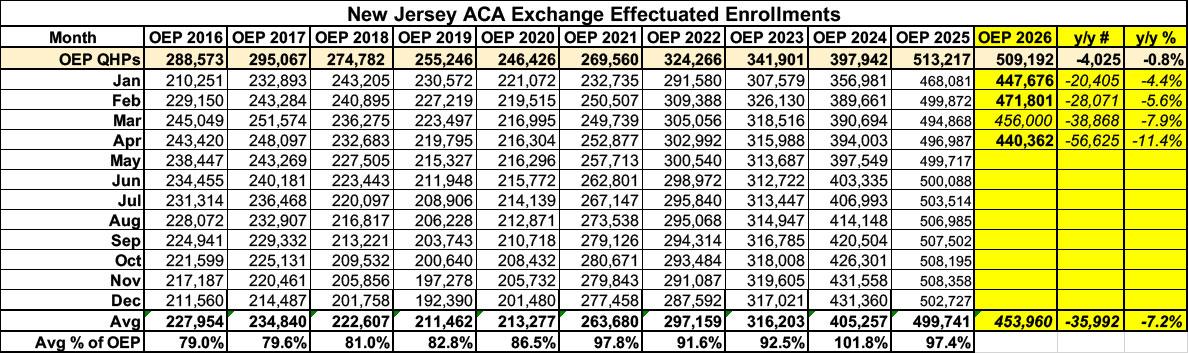
ACA exchange enrollment has dropped by 11.4% in New Jersey since Congressional Republicans allowed the enhanced federal subsidies to expire at the end of last year...despite NJ offering state-based subsidies to help mitigate the lost federal assistance.
Initial signups during Open Enrollment were only down 0.8% vs. OEP 2025...but effectuated enrollment was 4.4% lower year over year in January, gradually rising to 11.4% lower as of April, according to Get Covered NJ, the state ACA exchange.
That's over 56,000 Kansans who already lost coverage in just the first four months of the year...a number which has likely continued to climb since then.
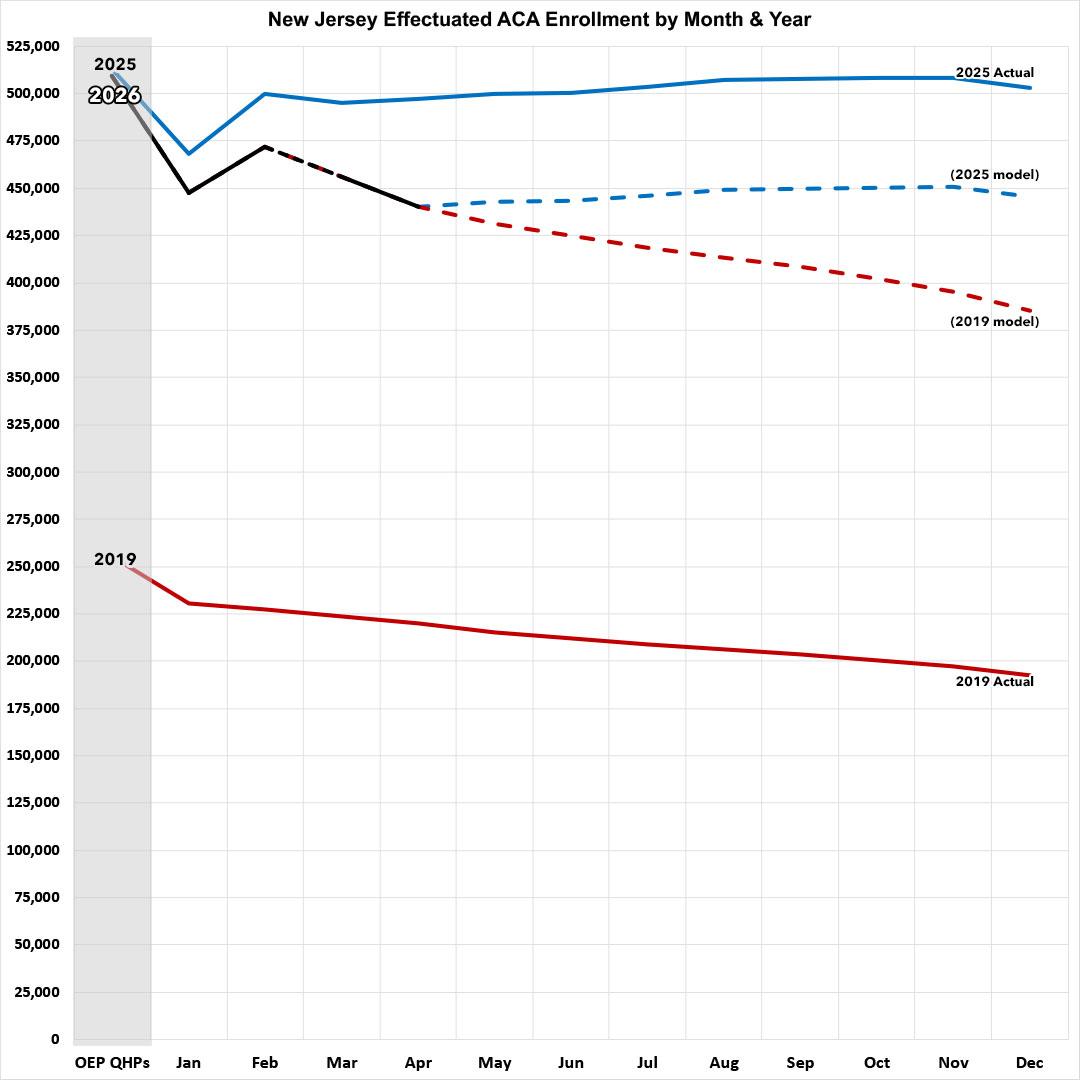
Here's what this looks like visually, with both 2025 and 2019 (the last pre-COVID year, which didn't include the enhanced subsidies) included for comparison:
Looking ahead to 2027, the preliminary rate filings for both the individual and small group markets are now available via the federal Rate Review database:
AmeriHealth HMO, Inc:
AmeriHealth HMO, Inc. ("AHNJ”) is revising premium rates for the New Jersey Individual Health ACA compliant products, effective from January 1, 2027. Rate increases average 18.2%, ranging from 18.2% to 18.2%. The proposed revisions to each plan are shown on the last page of this exhibit. About 17 members will be affected.
Proposed rate increases of 10% or higher:
- IHC Gold HMO Regional Preferred $20/$50 18.2%
There were no changes to the rating structure affecting premium rates.
Financial Experience of the Product:
The premium collected, risk adjustment transfer, and incurred claims for these products during the period January 1, 2025 to December 31, 2025 were $591,836.74, $1,187,168.69, and $2,492,999.89, respectively. The resulting “loss ratio” is 140%. This ratio is the portion of premium that is needed to pay medical claims. The complement of the loss ratio is the portion of premium needed for taxes and fees, administrative expenses, and margin. The projected loss ratio, using New Jersey’s requirements and taking into account the rate increase noted above, is 35%.
Changes in Taxes and Fees:
The Federal government discontinued the Health Insurance Providers Fee beginning for premiums due in 2021.
Changes in Medical Service Costs:
Increasing cost of medical services: Annual increases in reimbursement rates to healthcare providers, such as hospitals, doctors, and pharmaceutical companies. We estimate cost increases to be 4.5%. Increased utilization: The number of office visits and other services continues to grow. In addition, total healthcare spending will vary by the intensity of care and use of different types of health services. The price of care can be affected by the use of expensive procedures such as surgery versus simply monitoring or providing medications. We estimate utilization increases to be 4.7%.
Higher costs from deductible leveraging: Healthcare costs continue to rise every year. If deductibles and copayments remain the same, a higher percentage of healthcare costs need to be covered by health insurance premiums each year. We estimate deductible leveraging increases to be roughly 1%.
Changes in Benefits:
Some plan benefits are mandated by federal and state law. All changes in benefits are in compliance with the uniform modifications rules stipulated by the Federal government.
Administrative Costs:
Administrative Costs and anticipated margins make up approximately the same percentage of premium in 2027 that they do in 2026. The premium rates presented in this filing include a contribution to reserves.
AmeriHealth Insurance Co. of NJ:
AmeriHealth Insurance Company of New Jersey ("AHIC”) is revising premium rates for the New Jersey Individual Health ACA compliant products, effective from January 1, 2027. Rate increases average 17.0%, The proposed revisions to each plan are shown on the last page of this exhibit. About 131,000 members will be affected.
There were no changes to the rating structure affecting premium rates.
Financial Experience of the Product:
The premium collected, risk adjustment transfer, and incurred claims for these products during the period January 1, 2025 to December 31, 2025 were $985,710,024, -$131,451,940, and $740,632,945, respectively. The resulting “loss ratio” is 104%. This ratio is the portion of premium that is needed to pay medical claims. The complement of the loss ratio is the portion of premium needed for taxes and fees, administrative expenses, and margin. The projected loss ratio, using New Jersey’s requirements and taking into account the rate increase noted above, is 80%.
Changes in Taxes and Fees:
The Federal government discontinued the Health Insurance Providers Fee beginning for premiums due in 2021.
Changes in Medical Service Costs:
Increasing cost of medical services: Annual increases in reimbursement rates to healthcare providers, such as hospitals, doctors, and pharmaceutical companies. We estimate cost increases to be 4.6%.
Increased utilization: The number of office visits and other services continues to grow. In addition, total healthcare spending will vary by the intensity of care and use of different types of health services. The price of care can be affected by the use of expensive procedures such as surgery versus simply monitoring or providing medications. We estimate utilization increases to be 5.9%.
Higher costs from deductible leveraging: Healthcare costs continue to rise every year. If deductibles and copayments remain the same, a higher percentage of healthcare costs need to be covered by health insurance premiums each year. We estimate deductible leveraging increases to be roughly 1%.
Changes in Benefits:
Some benefits have been revised in some plans to moderate the impact of rising health care costs. The overall impact on rates of these changes is small.
Some plan benefits are mandated by federal and state law. Benefit changes for some plans were also made. All changes in benefits are in compliance with the uniform modifications rules stipulated by the Federal government.
Administrative Costs:
Administrative Costs and anticipated margins make up approximately the same percentage of premium in 2027 that they do in 2026. The premium rates presented in this filing include a contribution to reserves.
Horizon Healthcare Services Inc:
Horizon Blue Cross Blue Shield of New Jersey (Horizon-BCBSNJ) is increasing premium rates for the NJ Individual ACA-compliant products by an average of 15.4% for 2027 enrollments. Rate increases by product are displayed in the table below. Additionally, the final premium will depend on the member’s age and family composition.
Approximately 191K members are estimated to be impacted by rate actions exceeding 10%. Historical average yearly premium increases for Individual ACA-compliant products by Horizon-BCBSNJ:
- 2024: 4.2%
- 2025: 6.1%
- 2026: 18.1%
Horizon-BCBSNJ is subject to the State and Federal Minimum Loss Ratio requirements. This means that at least 80% of premium dollars – after risk adjustment and ACA-imposed fees and taxes - has to be spent on medical costs. The rate actions for 2027 are projected to meet this requirement.
Reasons contributing to the increase in premium rates include the following:
- Medical and prescription drug costs inflation. Service costs increase each year. The contributing factors include: health care providers increasing their fees, members utilizing more services and supplies, advances in prescription drug development and medical technology (such as gene therapies), and heavy marketing of Specialty drugs, among other factors.
- In 2026, the State Reinsurance parameters were revised, which resulted in carriers receiving about 40% less in reinsurance receivables for high-cost claimants. Rates had to increase in order to make up for this shortfall in funding.
Financial Experience of the Individual Block
The premium collected and incurred claims for these products during the January 2025 – December 2025 period were $2,182M and $1,998M, respectively. Reinsurance and Risk Adjustment receivables are anticipated to be $461M and $268M respectively. After accounting for ACA-imposed taxes and fees, this results in an anticipated NJ State one-year Medical Loss Ratio (MLR) of 86.2% for 2025. This ratio is the portion of premium that is needed to pay medical claims. The complement of the loss ratio is the portion of revenue needed for taxes and fees, administrative expenses, and margin.
The projected 2027 loss ratio on a one-year basis, using New Jersey’s requirements and taking into account the rate increase noted above, is 86.2%. The projected 2027 NJ loss ratio on a three-year basis, is 84.7%.
Changes in Benefits
Benefit coverage and cost sharing levels are two important components in determining premium levels and may be changed periodically. Cost Sharing changes, such as copay, coinsurance, deductible, maximum out pocket levels, may be made to any number of benefits, including but not limited to:
Primary Care and Specialist visits, Urgent Care visits, Inpatient Hospital stays, Outpatient Surgery procedures, Emergency Room visits, Prescriptions, Radiology Imaging, and Laboratory Testing, among others. Some benefit changes are also required by legislation or regulation.
Oscar Garden State Insurance Corp:
The purpose of this document, which is submitted in conjunction with the Part I Unified Rate Review Template (URRT), is to present rate change justification for Oscar Garden State Insurance Corporation (Oscar’s) individual Affordable Care Act (ACA) products, with an effective date of January 1, 2027, and to comply with the requirements of the Part II Justification.
Using in-force business as of March 2026, the proposed average rate increase for renewing plans is 29.3% and impacts an estimated 144,367 members. The minimum and maximum rate change percentages are 25.8% and 30.6%, respectively. Rate increases vary by plan due to a combination of factors including shifts in benefit leveraging and cost-sharing modifications. This rate increase is absent of rate changes due to attained age. Rate increases will not vary by member within a plan since the age factors and geographic factors will not change for the 2027 plan year.
2. Financial Experience
The total net premiums and medical expenses (claims costs +/- risk adjustment transfers) for these products during the January 1, 2025 to December 31, 2025 experience period were $230M and $193M, respectively. The resulting “loss ratio”, expressed as medical expenses over premiums, is 83.8%. This ratio represents the portion of premium that is needed to pay medical claims costs. The complement of the loss ratio is the portion of premium needed for taxes and fees, administrative expenses, and risk margin.
Oscar’s projected loss ratio for the 2027 plan year based on the federally-prescribed MLR methodology is 88.5%. Oscar’s projected loss ratio for 2027 based on the New Jersey methodology is 84.7%.
Changes in Medical Service Costs
The significant healthcare cost trends driving the proposed rate change include the following:
- Increased cost of medical services and prescription drug inflation: annual increases in reimbursement rates to healthcare providers, such as hospitals, doctors, and pharmaceutical companies. The estimated annual cost increase is 3.0%.
- Increased utilization: the number of office visits and other services continues to grow. In addition, total healthcare spending will vary by the intensity of care and use of different types of health services. The price of care can be affected by the use of expensive procedures such as surgery versus simply monitoring or providing medications. The estimated annual utilization increase is 1.8%.
- Higher costs from deductible leveraging: healthcare costs continue to rise every year. If deductibles and copayments remain the same, a higher percentage of healthcare costs need to be covered by health insurance premiums each year. The estimated deductible leveraging increase is about 0.4%.
4. Changes in Benefits
Plan benefits have been revised as a result of changes in the Center for Medicare and Medicaid Services (CMS) Actuarial Value requirements, as well as for strategic product considerations.
5. Administrative Costs and Anticipated Margins
Oscar anticipates changes in both administrative expenses and targeted risk margin from what was included in the current premium rates. Overall administrative expense load increased from 14.9% to 16.4%. Targeted risk margin after federal income taxes is 4.3%, which is aligned with last year’s target of 3.4%.
UnitedHealthcare:
The following memorandum describes the key drivers of the rate increase effective January 1st, 2027, for UnitedHealthcare Insurance Company (“UHIC”). UHIC policies are individual medical plans offered in New Jersey and are fully compliant with the Patient Protection and Affordable Care Act.
Rate Change
The overall average rate change is 35.7%. The rate change by plan varies from 28.3% to 39.6%.
Number of Individuals Impacted
There are 7,820 individuals impacted as of April 30th, 2026.
Financial Experience of Product
The premium collected between January 1st, 2025 and December 31st, 2025 was $108,434,989. Incurred claims net of reinsurance during this period were $78,222,799 and UHIC is estimated to receive $1,332,786 from the risk adjustment program. The loss ratio, or portion of premium required to pay medical claims, for this time period is 70.9%.
Key Drivers of Change in Medical Service Costs
- Increasing Cost of Medical Services: Annual increases in reimbursement rates to health care providers – such as hospitals, doctors, and pharmaceutical companies.
- Increased Utilization: The number of office visits and other services continues to grow. In addition, total health care spending will vary by the intensity of care and use of different types of health services. The price of care can be affected by the use of expensive procedures such as surgery versus simply monitoring or providing medications.
- Higher Costs from Deductible Leveraging: While health care costs continue to rise every year, if deductibles and copayments remain the same, a greater percentage of health care costs need to be covered by health insurance premiums each year.
- Impact of New Technology: Improvements to medical technology and clinical practice require use of more expensive services - leading to increased health care spending and utilization.
- Demographics: Change in the projected age, gender, and metal mix of the underlying population can change the medical claims expected to be incurred.
- Morbidity: Change in the projected health status of both the New Jersey individual market and UHIC’s population lead to increased healthcare spending and a decrease in the offsetting impact of the risk adjustment program.
- Regulatory Changes: The changes to federal premium subsidy eligibility for consumers are expected to lead to higher costs as healthier enrollees exit the market.
Changes in Benefits
Changes in covered benefits or benefit plan designs impact costs and therefore affect premium changes. Benefit plans are typically changed for one of three reasons: to comply with the requirements of the Affordable Care Act, to respond to consumer feedback, or to address a particular medical cost issue to provide for greater long-term affordability of the product. The Affordable Care Act implemented requirements for the “value” that must be offered by plan designs in the Individual and Small Group markets. These are called “metal levels”. For a benefit plan to remain classified within a particular metal level from year to year, adjustments to deductibles, copayments or coinsurance are sometimes required. These adjustments impact the cost and therefore the premium increases for the plan.
Administrative Costs and Anticipated Margins
UHIC works to directly control administrative expenses by adopting better processes and technology, and through the development of programs and innovations that make health care more affordable. UHIC has led the marketplace by introducing key innovations that make health care services more accessible and affordable for customers, improve the quality and coordination of health care services, and help individuals and their physicians make more informed health care decisions. Changes in these non-benefit costs can impact the rate increase.
State and Federal government-imposed taxation and fees are significant factors that impact health care spending and must be included in the administrative costs associated with the plans.
WellCare Health Insurance Co (Ambetter):
WellCare Health Insurance Company of New Jersey, Inc. is filing rates for the individual block of business, effective January 1, 2027. This document is submitted in conjunction with the Part I Unified Rate Review Template and the Part III Actuarial Memorandum.
This information is intended for use by the New Jersey Department of Banking and Insurance, the Center for Consumer Information and Insurance Oversight (CCIIO), and health insurance consumers in New Jersey to assist in the review of WellCare Health Insurance Company of New Jersey, Inc.’s individual rate filing.
The results are actuarial projections. Actual experience will differ for a number of reasons, including population changes, claims experience, and random deviations from assumptions.
In 2025, earned premium was $628.39 per member per month (PMPM). Incurred claims in 2025 were $374.50, or 59.60% of premium. Netting risk adjustment from the claims results in an estimated loss ratio (incurred claims net of estimated risk adjustment transfers, divided by earned premiums) of 61.91%. We expect unit costs to increase for 2027. Further, we have updated underlying experience for the single risk pool, expected administrative expense, and assumptions for federal risk adjustment. These factors, as well as changes to the assumed morbidity of the single risk pool and medical trend, result in a premium rate increase.
Medical trend, or the increase in health care costs over time, is composed of two components: the increase in the unit cost of services and the increase in the utilization of those services. Unit cost increases occur as care providers and their suppliers raise their prices. Utilization increases can occur as people seek more services than before. Additionally, simple services can be replaced with more complex services over time, which is known as service intensity trend. An example of service intensity trend would be the replacement of an X-ray with an MRI scan. Replacing the service with a more intense service causes the total cost of medical services to increase.
The proposed rate change of 20.8% applies to approximately 2,155 individuals. WellCare Health Insurance Company of New Jersey, Inc.’s projected administrative expenses for 2027 are $97.47 PMPM. Administrative expense does not include $77.27 for taxes and fees. The historical administrative expenses for 2026 were $81.38 PMPM, which excludes taxes and fees. The projected loss ratio is 87.0% which satisfies the federal minimum loss ratio requirement of 80.0%.
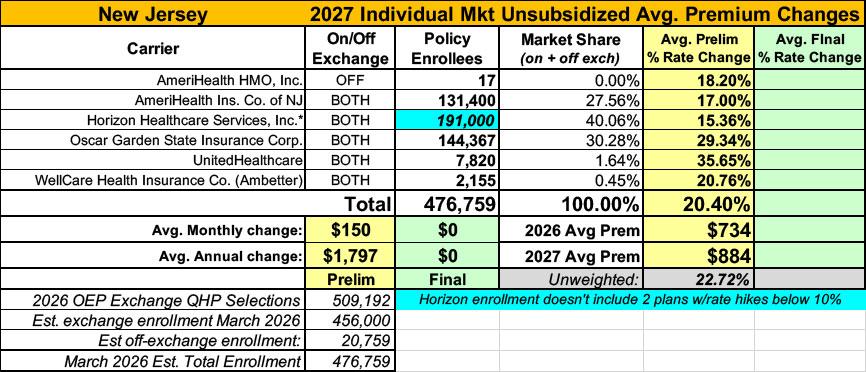
It's worth noting that Horizon Healthcare Services is only including effectuated enrollees in plans where they're requesting rate hikes of 10% or higher...which happens to include nearly all of them, but there are two which fall below 10% which aren't included. I don't know how many enrollees are in either of those plans specifically.
Overall, the weighted average rate increase being requested by New Jersey carriers participating in the individual market in 2027 is 20.4%. If approved as is, this would mean unsubsidized enrollees would be hit with an additional ~$1,800 premium increase next year on average:
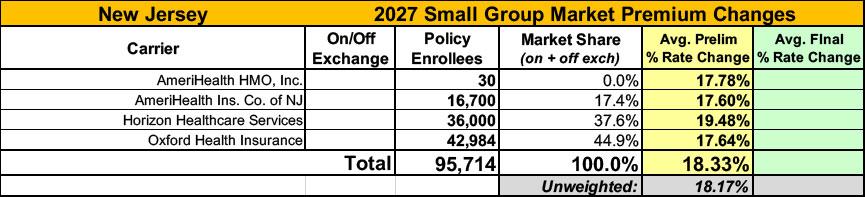
Meanwhile, the New Jersey small group market is looking at average rate increases of 18.3%:
Advertisement


