


2027 Rate Changes - Arizona: +29% indy market, +20% sm. group
Mon, 08/10/2026 - 10:40am
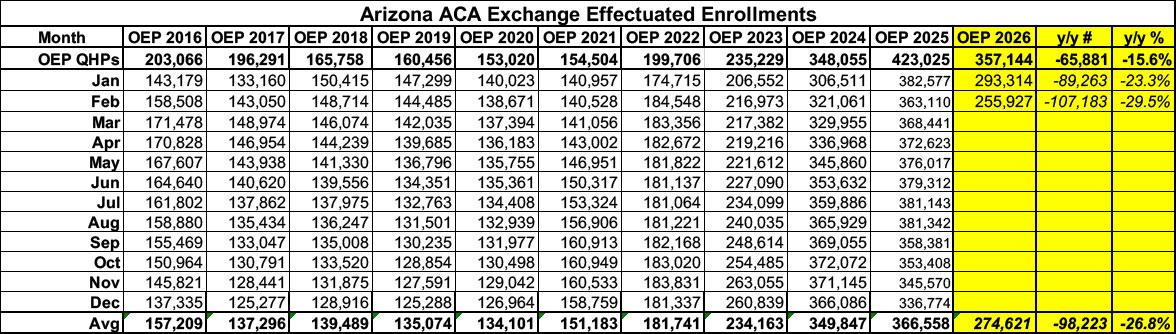
ACA exchange enrollment has dropped by nearly 30% in Arizona since Congressional Republicans allowed the enhanced federal subsidies to expire at the end of last year.
Initial signups during Open Enrollment were already down 15.6% vs. OEP 2025...and effectuated enrollment was 23% lower year over year in January, rising to nearly 30% by February.
That's over 107,000 Arizonans who already lost coverage in just the first two months of the year...a number which has likely continued to climb since then.
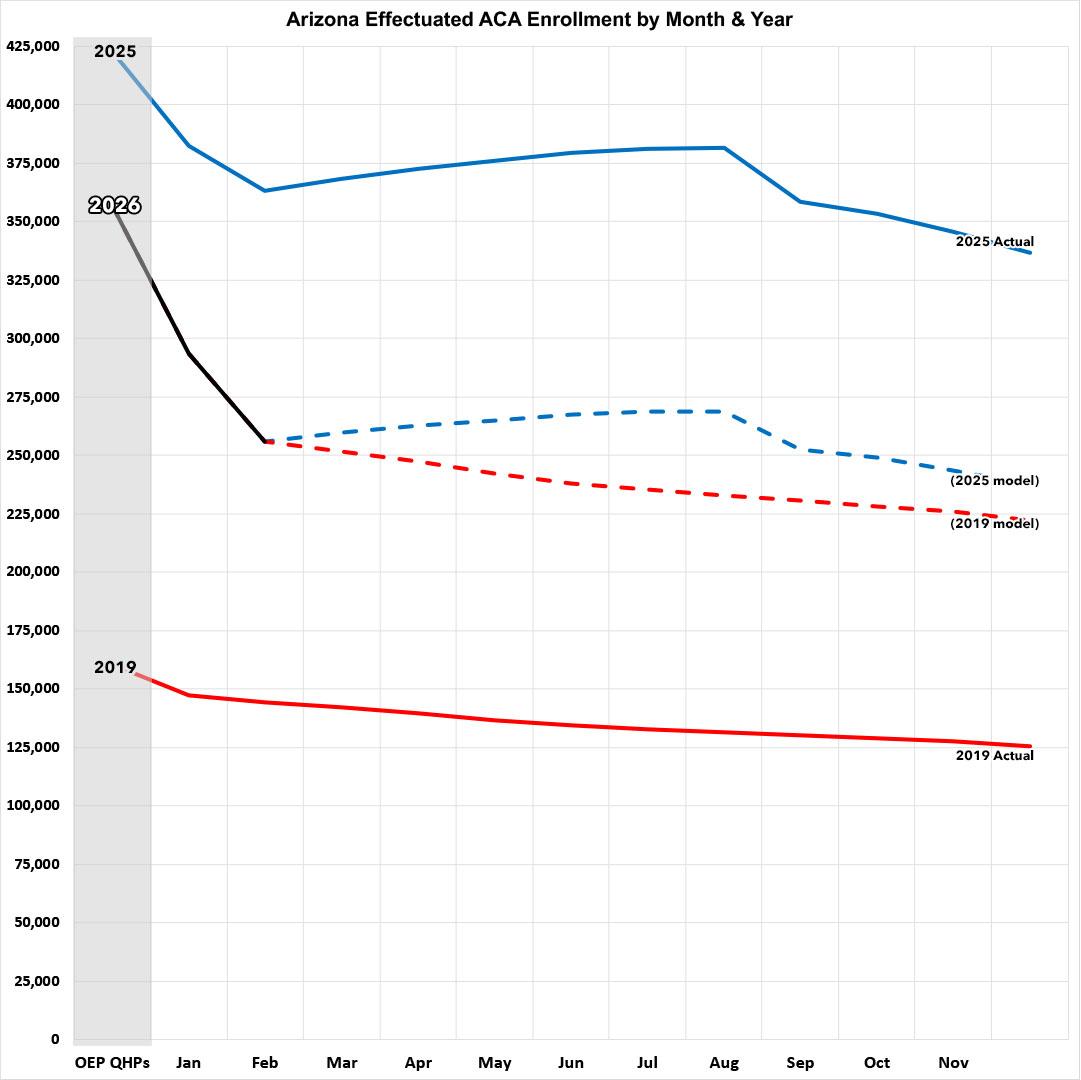
Here's what this looks like visually, with both 2025 and 2019 (the last pre-COVID year, which didn't include the enhanced subsidies) included for comparison:
Looking ahead to 2027, the preliminary rate filings for both the individual and small group markets are now available via the federal Rate Review database:
ANTIDOTE HEALTH PLAN OF AZ:
Antidote’s average proposed rate increase of 3.26%, effective January 1, 2027, is expected to impact 11,094 members based on May 2026 membership. The rate increase is the same for all adult members within a given plan, though it varies by plan, ranging between 1.30% and 16.11%. Rate changes vary by plan due to the impact of changes in benefits and changes to the Cost Sharing Reduction (CSR) shortfall load.
HIOS ID 68445AZ0010120 has a proposed rate change of 16.11%, which is above the threshold limit requiring a Part II – Written Description Justifying the Rate Increase. All other renewing HIOS IDs offered in 2027 have proposed rate increases below this threshold.
Changes in Medical Service Costs
Medical trend for these products is anticipated to be an average of 7.5% per year on allowed claims. Medical trends include a combination of utilization and costs of services. This is an increase in annual trend from the 2026 rate development and is included in the calculation of the rate increase.
Morbidity
We include a morbidity increase to claims relative to Antidote’s manual rate to account for the expiration of enhanced subsidies at the end of the 2025 plan year, consistent with current regulations. This adjustment results in a net 8.1% increase to the manual rate.
Risk Adjustment
We include a risk adjustment transfer payment based on Antidote’s anticipated competitive position in 2027, with the expectation that Antidote’s competitive positioning may garner substantial new enrollment. We expect the newly enrolled population to have a health status similar to the Arizona statewide average, but given Antidote has no prior experience with these new members, we anticipate Antidote will have less ability to fully capture all applicable diagnoses information. We expect this will ultimately lead to a payable into the risk adjustment program for 2027.
Retention
We include retention as provided by Antidote for 2027, including a reduction to profit from 5.0% in 2026 to 4.0% in 2027 and a required federal exchange fee decrease relative to 2026. This impact slightly offsets the increases noted above.
BLUE CROSS BLUE SHIELD OF AZ
BCBSAZ is filing an average rate increase for plans in the Arizona Individual market of 29.59%, varying between 19.38% and 32.62%, excluding federally prescribed age factors. The average increase is calculated from the most recently implemented rates which were effective January 1, 2026. This increase will be effective on January 1, 2027 and will affect 33,957 Arizona policyholders (as of March 2026). The following considerations were included in the development of the filed rates.
Financial Experience of the Product
The Affordable Care Act requires insurance companies in the Individual market to spend at least 80% of premium dollars on medical care, and to issue rebates to members if less than 80% of premium dollars are spent on medical care. AZ Blue historical rates have exceeded these minimum loss ratio requirements. Likewise, AZ Blue 2027 filed rates are projected to exceed minimum loss ratio requirements.
AZ Blue has been a plan sponsor in the ACA Individual market in Arizona since 2014. AZ Blue offers plans with competitive rates while consistently exceeding minimum loss ratio requirements. Likewise, 2027 AZ Blue filed rates are expected to exceed minimum loss ratio requirements.
Changes in Medical Service Costs
Medical trend rates have continued to increase in many markets including the Individual market in Arizona. AZ Blue filed rates reflect the anticipated utilization patterns for our Individual enrollees and fee increases for facilities and providers in AZ Blue networks and out-of-network.
Changes in Benefits
AZ Blue will offer a streamlined portfolio of plans in 2027 with continued focus on providing high quality affordable coverage. AZ Blue benefit designs are updated annually to align with federal requirements by metal level for actuarial plan values. Variations in the benefits offered in 2027 from those offered in 2026 are the primary cause of variation in rate changes between plans.
Administrative Costs and Anticipated Margins
In addition to the cost of medical services, there are a number of administrative costs associated with providing policies to members. These costs include items such as commissions, employee salaries, quality initiatives, fraud waste & abuse prevention, regulatory costs, utilities, member services and provider services. AZ Blue’s administrative costs support our commitment to providing affordable and high-quality Individual health plans in the Arizona market.
HEALTH NET COMMUNITY SOLUTIONS OF AZ:
Scope and Range of the Rate Increase
Health Net Community Solutions of Arizona (HNCS) currently provides health care coverage for over 2,000 members enrolled in our Ambetter Health Solutions plans. Premium rates are expected to increase on average by 28.0% for members on renewing plans, effective January 1, 2027. Annual rate changes may range between 19.2% and 31.0%, depending on what county current enrollees reside in and their current plan selection. Variations are primarily driven by underlying cost differences between different plan designs and regional cost trends. Note that these rate changes do not reflect any additional increases in a member’s calculated premium driven by aging an additional year at the point of renewal.
Financial Experience of the Product
HNCS does not have sufficient historical experience to base projections using issuer specific data. Projected costs were instead developed using 2025 experience from Health Net of Arizona Inc., dba Arizona Complete Health (AZCH), an affiliate company which covered over 110,000 lives in Arizona’s Individual market during 2025, adjusted for HNCS’ expected population in 2027.
For reference, AZCH incurred $730,934,241 in estimated paid claims costs, gross of an estimated risk transfer payable of $706,318 from the federal risk adjustment program in 2025. AZCH collected $645,406,792 in premium revenue, resulting in an estimated loss ratio of 113.4% inclusive of federal risk transfer payments for 2025.
Changes in Medical Service Costs
The claims experience used as a starting point in our pricing is trended forward for projected changes in medical service costs and calibrated to HNCS’ expected population in 2027. Medical service costs are projected to increase at an annualized rate of 10.1% due to medical inflation, expected changes in contracted reimbursement rates to providers, and increased utilization of health care services. Other factors related to expected changes in the demographics of HNCS’ population and overall population health are expected to drive additional increases in medical costs. Emerging trends that indicate the overall health of the insurance pool is worsening, in addition to elevated claims experience emerging in 2026 is a key driver for the proposed rate increase.
Changes in Benefits
Changes in plan benefits and member cost sharing also impact the proposed rate change. Some benefits have been adjusted, such as coverage for acupuncture, vision, and dental care. Changes in covered benefits and cost sharing can also influence how often members use medical services.
Overall, benefit changes are expected to drive a 2.2% decrease to total projected medical costs. Additionally, changes to deductibles, copayments, and other cost sharing features affect how these medical costs are split between plans and members. Based on the proposed mix of plan designs for 2027, HNCS is expected to cover approximately 81% of claims costs in 2027, with the remainder being covered by members through cost sharing.
Administrative Costs and Anticipated Margins
HNCS anticipates administrative costs to increase by $26 per member per month compared to what was assumed for 2026 rates. Taxes and fees are expected to decrease as a percentage of premium by 0.4%. The target profit margin for 2027 is set to 0.8% of premium, decreasing compared to the margin targeted for 2026 rates.
HEALTH NET OF AZ (AZ COMPLETE):
Arizona Complete Health (AZCH) currently provides health care coverage for over 43,000 members enrolled in our Ambetter plans. Premium rates are expected to increase on average by 24.5% for members on renewing plans, effective January 1, 2027. Annual rate changes may range between 17.0% and 29.8%, depending on what county current enrollees reside in and their current plan selection. Variations are primarily driven by underlying cost differences between different plan designs and regional cost trends. Note that these rate changes do not reflect any additional increases in a member’s calculated premium driven by aging an additional year at the point of renewal.
Financial Experience of the Product
AZCH incurred $730,934,241 in estimated paid claims costs, gross of a risk transfer receivable of $29,099,851 from the federal risk adjustment program in 2025. AZCH collected $645,406,792 in premium revenue, resulting in an estimated loss ratio of 108.7% inclusive of federal risk transfer payments for 2025.
Changes in Medical Service Costs
Medical service costs are projected to increase at an annualized rate of 10.3% due to medical inflation, expected changes in contracted reimbursement rates to providers, and increased utilization of health care services. Other factors related to expected changes in the demographics of AZCH’s population and overall population health are expected to drive additional increases in medical costs. Emerging trends that indicate the overall health of the insurance pool is 1worsening, in addition to elevated emerging claims experience in 2026 is a key driver for the proposed rate increase.
Changes in Benefits
Benefit changes are not a material contributor to the proposed rate change.
Administrative Costs and Anticipated Margins
AZCH anticipates administrative costs to increase by $20 per member per month compared to what was assumed for 2026 rates. Taxes and fees are expected to decrease as a percentage of premium by 0.6%. The target profit margin for 2027 is set to 3.95% of premium, remaining the same as what was set for 2026 rates.
IMPERIAL INSURANCE COMPANIES:
Imperial Insurance Companies, Inc. (Imperial) has submi ed its 2027 filing for its Individual HMO product. The weighted average premium increase is 30.0%, with a minimum and maximum increase by plan of 25.2% and 34.1% respectively.
Key Drivers for this Filing
Changes in Medical Service costs:
A main driver of premium increases includes changes to anticipated medical costs and utilization of services. The estimated impact is approximately 9% to the filed increase. The main driver of trend are medical unit cost increases and pharmacy unit cost and utilization increases.
Administrative Costs:
Imperial’s estimated risk adjustment liability is expected to increase with the estimated impact of 12%.
Changes in Benefits:
The 2027 premiums contain benefit changes including changes to:
- cost sharing provisions
- out of pocket maximums
Standard plan’s benefit changes were mandated by law.
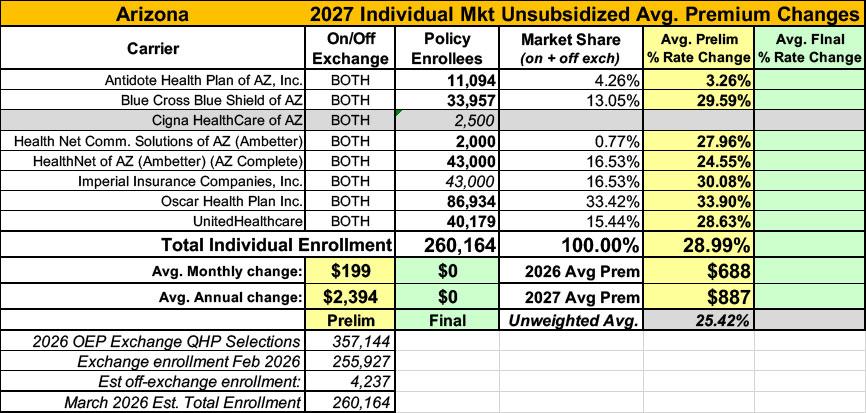
Unfortunately, Imperial Insurance didn't include the number of effectuated enrollees as of spring 2026; I've come up with a guesstimate of around 43,000 enrollees based on the number of effectuated exchange enrollees statewide in February. Even if this estimate is off significantly it would only move the needle slightly on the overall weighted average, however, since it would still be ~28.9% without any Imperial enrollees (see table below).
OSCAR HEALTH PLAN:
The purpose of this document is to present rate change justification for Oscar Health Plan, Inc. (Oscar’s) (HIOS ID 13877) Individual Affordable Care Act (ACA) products, with an effective date of January 1, 2027, and to comply with the requirements of Section 2794 of the Public Health Service Act as added by Section 1003 of the Patient Protection and Affordable Care Act (ACA).
Using in-force business as of March 2026 , the proposed average rate increase for renewing plans is 33.9%. Rate increases vary by plan due to a combination of factors including shifts in benefit leveraging and cost-sharing modifications. This rate increase is absent of rate changes due to attained age.
The rate increase impacts an estimated 86,934 members.
2. Reason for Rate Increase(s)
The significant factors driving the proposed rate change include the following:
Medical and Prescription Drug Infl ation and Utilization Trends
The projected premium rates reflect the most recent emerging experience which was trended for anticipated changes due to medical and prescription drug inflation and utilization.
Administrative Expenses, Taxes and Fees, and Risk Margin
Changes to the overall premium level are needed because of required changes in federal and state taxes and fees. In addition, there are anticipated changes in both administrative expenses and targeted risk margin.
Prospective Benefit Changes
Plan benefits have been revised as a result of changes in the Center for Medicare and Medicaid Services (CMS) Actuarial Value Calculator and state requirements, as well as for strategic product considerations.
Anticipated Changes in the Average Morbidity of the Covered Population due to the ending of the enhanced premium tax credit subsidies as well as the finalization of the 2025 Marketplace Integrity and Affordability Rule Changes to the overall premium level are needed because of anticipated changes in the underlying morbidity of the projected marketplace.
Anticipated Changes in the Network Confi guration
Changes to the overall premium level are needed because of anticipated changes in the underlying network configuration and associated unit costs.
UNITEDHEALTHCARE:
UHCAZ is filing 2027 rates for individual products. The proposed rate change is 28.63% and will affect 40,179 individuals. The rate changes vary between 25.83% and 30.72%. Given that the rate changes are based on the same single risk pool, the rate changes vary by plan due to plan design changes.
Financial Experience of the Product
The premium collected in plan year 2025 was $498,686,045. Incurred claims during this period were $428,498,127 and UHCAZ expects payments of $53,533,196 for risk adjustment. The loss ratio, or portion of premium required to pay medical claims, for plan year 2025 is 96.26%.
Changes in Medical Service Costs
There are many different healthcare cost trends that contribute to increases in the overall U.S. healthcare spending each year. These trend factors affect health insurance premiums, which can mean a premium rate increase to cover costs. Some of the key healthcare cost trends that have affected this year’s rate actions include:
- Increasing cost of medical services: Annual increases in reimbursement rates to healthcare providers, such as hospitals, doctors, and pharmaceutical companies.
- Increased utilization: The number of office visits and other services continues to grow. In addition, total healthcare spending will vary by the intensity of care and use of different types of health services. The price of care can be affected using expensive procedures such as surgery versus simply monitoring or providing medications.
- Higher costs from deductible leveraging: Healthcare costs continue to rise every year. If deductibles and copayments remain the same, a higher percentage of healthcare costs need to be covered by health insurance premiums each year.
- Impact of new technology: Improvements to medical technology and clinical practice often result in the use of more expensive services, leading to increased healthcare spending and utilization.
- Changes in market morbidity: Expanded and enhanced federal premium tax credits for consumers expired at the end of 2025. Premiums reflect the expected increase in the average cost per member due to healthier members leaving the market.
Changes in Benefits
Changes in benefits impact costs and therefore affect premium changes. Plan benefits are typically changed for one of three reasons: to comply with the requirements of the Affordable Care Act or state law, to respond to consumer feedback, or to address a particular medical cost issue to provide greater long-term affordability of the product.
The Affordable Care Act implemented requirements for the “value” that must be offered by plan designs in the Individual and Small Group markets. These are called “metal levels”. For a benefit plan to remain classified within a particular metal level from year to year, adjustments to deductibles, copayments or coinsurance are sometimes required. These adjustments impact the cost and therefore the premium increases for the plan.
Administrative Costs and Anticipated Margins
UHCAZ works to directly control administrative expenses by adopting better processes and technology and developing programs and innovations that make healthcare more affordable. We have led the marketplace by introducing key innovations that make healthcare services more accessible and affordable for customers, improve the quality and coordination of healthcare services, and help individuals and their physicians make more informed healthcare decisions.
Taxes and fees imposed by the state and federal government are significant factors that impact healthcare spending and must be included as additional administrative costs associated with the plans. These fees include Affordable Care Act taxes and fees which impact health insurance costs and need to be reflected in premium. Another component of premium is margin, which is set to address expected volatility and risk in the market.
The requested rate change is anticipated to be sufficient to cover the projected benefit and administrative costs for the 2027 plan year.
It's also worth noting that Cigna Healthcare is pulling out of every state's individual market, including Arizona...I don't know exactly how many effectuated enrollees they have in AZ but it was only around 2,500 as of a year earlier.
Combined, these all amount to a whopping 29% weighted average rate increase for unsubsidized enrollees in 2027, pushing the average per enrollee up to around $890 per month:
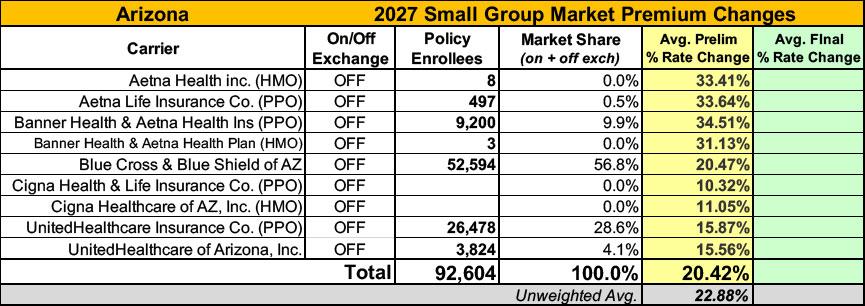
Meanwhile, Arizona's small group market enrollees are looking at a non-weighted average rate increase of nearly 23% and a semi-weighted increase of 20.4% (unfortunately, both divisions of Cigna redacted their effectuated enrollment numbers; these would knock the weighted average down somewhat given that they're requesting hikes of 10-11% respectively):
Advertisement


