


2027 Rate Changes - Wyoming: +11.3% indy market; +10% sm. group market
Mon, 08/17/2026 - 1:26pm
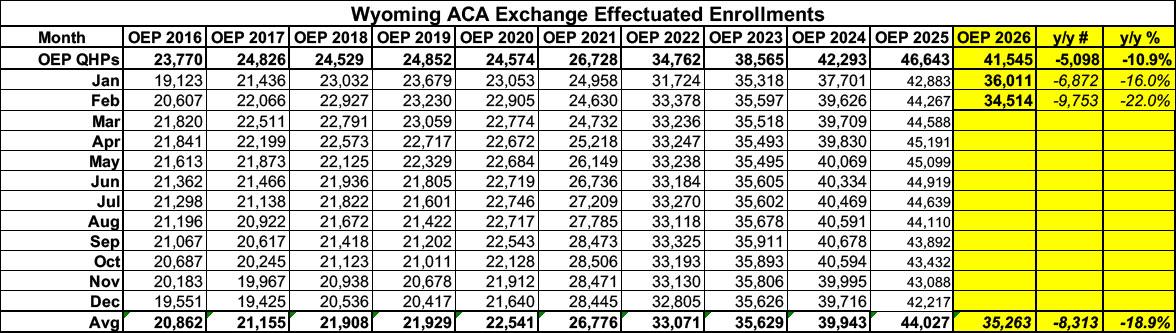
ACA exchange enrollment has dropped by 22% in Wyoming since Congressional Republicans allowed the enhanced federal subsidies to expire at the end of last year.
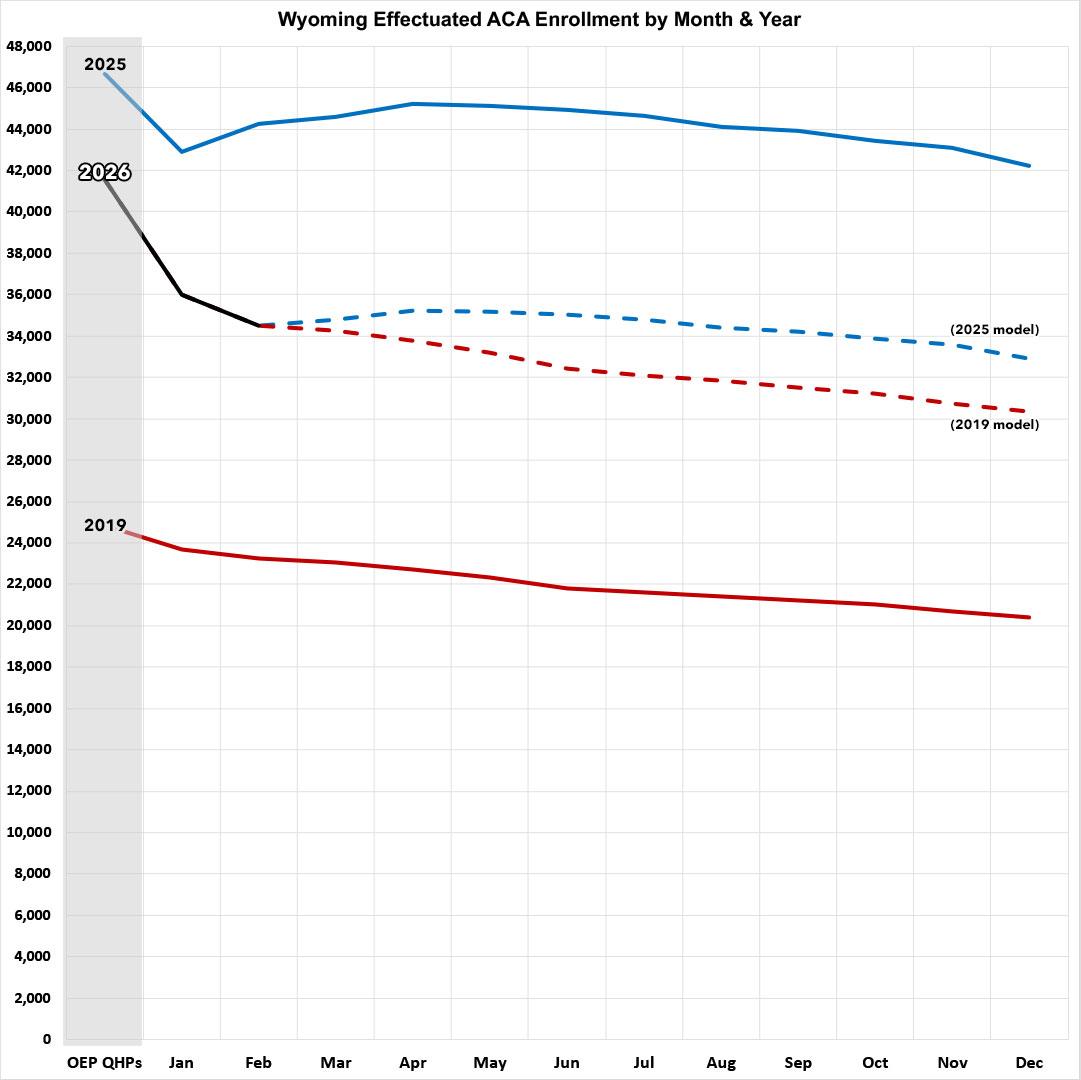
Initial signups during Open Enrollment were already down 11% vs. OEP 2025...and the drop-off grew to 16% year over year as of January and 22% as of February. That's nearly 10,000 Wyomingites who have lost ACA healthcare coverage in just the first two months of the year. While this may sound like a pretty small number, it's huge when you consider that Wyoming only has around 590,000 residents total.
Here's what this looks like visually, with both 2025 and 2019 (the last pre-COVID year, which didn't include the enhanced subsidies) included for comparison:
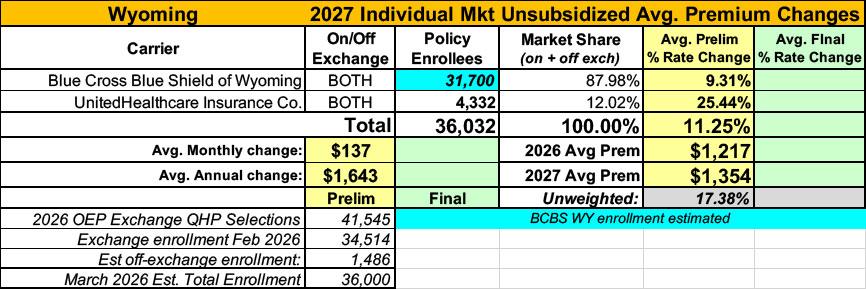
Looking ahead to 2027, the preliminary rate filings for both the individual and small group markets are now available via the federal Rate Review database:
Blue Cross Blue Shield of WY:
The proposed rate changes are the result of updated experience and revised projection factors, including annual claims trend. The proposed rate changes vary by plan due to changes in benefits, and therefore the paid to allowed ratios underlying the actuarial value and cost sharing component of the Plan Adjusted Index Rates (PAIRs). The paid to allowed ratios were updated to reflect revised benefits and were updated to reflect the anticipated claim costs associated with the projected 2027 BCBSWY Individual ACA population. The induced utilization assumptions for silver level plans reflect the paid to allowed ratio associated with the base silver level benefits.
The premium rates were developed using a single risk pool approach, and differences in the morbidity of the population enrolling in each plan were not reflected at the rating area, plan, or product level. Additionally, the paid to allowed ratios were developed using Oliver Wyman’s proprietary Medical Actuarial Relative Value (MarVAL™) model. MarVAL™ produces paid to allowed ratios based on a standard population and does not reflect differences in the morbidity of the individuals expected to enroll in a given plan.
Unfortunately, BCBSWY's actuarial memo is heavily redacted, so I'm unable to run a properly weighted average rate hike (see below).
UnitedHealthcare Insurance Co:
UHIC is filing 2027 rates for individual products. The proposed rate change is 25.44% and will affect 4,332 individuals. The rate changes vary between 21.63% and 26.51%. Given that the rate changes are based on the same single risk pool, the rate changes vary by plan due to plan design changes.
Financial Experience of the Product
The premium collected in plan year 2025 was $37,994,242. Incurred claims during this period were $30,111,090 and UHIC expects to pay $4,728,027 for risk adjustment. The loss ratio, or portion of premium required to pay medical claims, for plan year 2025 is 90.52%.
Changes in Medical Service Costs
There are many different healthcare cost trends that contribute to increases in the overall U.S. healthcare spending each year. These trend factors affect health insurance premiums, which can mean a premium rate increase to cover costs. Some of the key healthcare cost trends that have affected this year’s rate actions include:
- Increasing cost of medical services: Annual increases in reimbursement rates to healthcare providers, such as hospitals, doctors, and pharmaceutical companies.
- Increased utilization: The number of office visits and other services continues to grow. In addition, total healthcare spending will vary by the intensity of care and use of different types of health services. The price of care can be affected using expensive procedures such as surgery versus simply monitoring or providing medications.
- Higher costs from deductible leveraging: Healthcare costs continue to rise every year. If deductibles and copayments remain the same, a higher percentage of healthcare costs need to be covered by health insurance premiums each year.
- Impact of new technology: Improvements to medical technology and clinical practice often result in the use of more expensive services, leading to increased healthcare spending and utilization.
- Changes in market morbidity: Expanded and enhanced federal premium tax credits for consumers expired at the end of 2025. Premiums reflect the expected increase in the average cost per member due to healthier members leaving the market.
Changes in Benefits
Changes in benefits impact costs and therefore affect premium changes. Plan benefits are typically changed for one of three reasons: to comply with the requirements of the Affordable Care Act or state law, to respond to consumer feedback, or to address a particular medical cost issue to provide greater long-term affordability of the product.
The Affordable Care Act implemented requirements for the “value” that must be offered by plan designs in the Individual and Small Group markets. These are called “metal levels”. For a benefit plan to remain classified within a particular metal level from year to year, adjustments to deductibles, copayments or coinsurance are sometimes required. These adjustments impact the cost and therefore the premium increases for the plan.
Administrative Costs and Anticipated Margins
UHIC works to directly control administrative expenses by adopting better processes and technology and developing programs and innovations that make healthcare more affordable.
We have led the marketplace by introducing key innovations that make healthcare services more accessible and affordable for customers, improve the quality and coordination of healthcare services, and help individuals and their physicians make more informed healthcare decisions.
Taxes and fees imposed by the state and federal government are significant factors that impact healthcare spending and must be included as additional administrative costs associated with the plans. These fees include Affordable Care Act taxes and fees which impact health insurance costs and need to be reflected in premium. Another component of premium is margin, which is set to address expected volatility and risk in the market.
The requested rate change is anticipated to be sufficient to cover the projected benefit and administrative costs for the 2027 plan year.
As noted above, the BCBS WY actuarial memo is heavily redacted, so I had to make an educated guess as to how many enrollees they have based on the confirmed February on-exchange enrollment, the hard March enrollment in UHC plans, and an assumption of perhaps 1,500 off-exchange enrollees statewide.
Assuming my estimate is fairly accurate (31.7K BCBS enrollees), that would make the weighted average across both carriers 11.3%...which is actually at the lower end of the increases for 2027, except that Wyoming already has among the highest unsubsidized ACA premiums in the country to begin with, at over $1,200 per enrollee per month.
This means that even a "modest" 11.3% average increase will result in unsubsidized Wyoming enrollees having to pay a stunning $1,350/month in premiums alone next year.
Meanwhile, Wyoming's small group market carriers are seeking non-weighted average rate increases of 10.0%:

Advertisement


